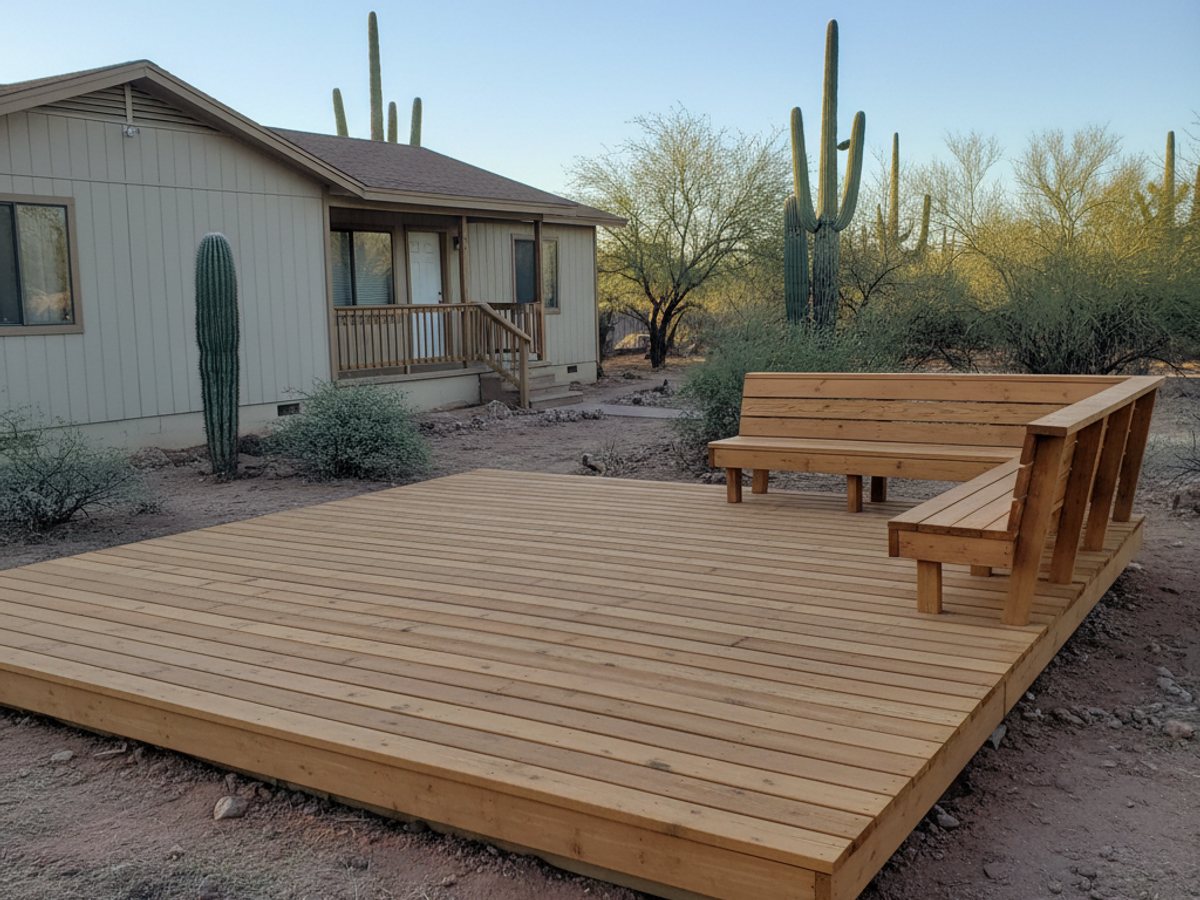
Tucson has a specific set of problems that a deck has to solve, and not every builder who shows up with a truck and a tape measure has actually solved them before. Before you get to price, get to whether the person in front of you understands the ground, the sun, and the water on your particular lot.
What's actually under your yard
Most of the Tucson valley has a layer of caliche somewhere between 12 and 24 inches down, sometimes shallower. It's a cemented calcium carbonate hardpan, and it does not behave like regular dirt. A post hole digger bounces off it. A footing that just sits on top of it, or worse, one dug into a soft pocket next to it, can settle unevenly over a few years and take your railing posts out of plumb with it. A builder who's worked here knows to break through the caliche layer or engineer around it, not just dig 12 inches and call it done. If someone quotes your footings without ever asking about the soil, or without mentioning caliche at all, that's worth a follow-up question.
Frost isn't really the issue here the way it is up north. We get a handful of nights near freezing in December and January, not a frost line that drives footing depth. What drives it in Tucson is soil bearing capacity and that caliche layer, plus code minimums, which is a different conversation than what a builder trained in a colder climate is used to having.
Licensing and insurance, and what to actually ask for
Arizona requires a Registrar of Contractors (ROC) license for any job over $1,000, which covers essentially every deck project. Ask for the license number and look it up on the ROC's website yourself, don't take a business card's word for it. Check that it's current, not expired or suspended. Ask for proof of general liability insurance and, if they have employees, workers' comp. If a deck collapses because a ledger board pulled off the house, or a worker gets hurt on your property, you do not want to be the one holding that.
A lot of small deck jobs get done by handymen without a license at all. That's technically illegal in Arizona above the dollar threshold, and it also means no recourse through the ROC's complaint process if the work fails. Cheaper up front, more expensive if the ledger flashing was never installed and water gets behind your siding in year three.
Permits: how it actually works here
Depending on where your lot sits, permits come through the City of Tucson Planning and Development Services or Pima County Development Services if you're outside city limits, in places like unincorporated areas around Vail, Corona de Tucson, or parts of Marana and Oro Valley before annexation. A raised deck attached to the house almost always needs a permit. A low platform deck a few inches off grade sometimes doesn't, depending on height and whether it's attached. A builder should know which one your project falls into and pull the permit themselves, not hand you paperwork to figure out on your own.
Expect at least two inspections on an attached deck: one for the footings before concrete gets poured, and one for framing before the decking boards go down. Skipping the footing inspection to save a week is the single most common shortcut on decks that fail permit review later, or that fail structurally when someone finally notices the posts aren't sitting on what they should be.
If you're in a subdivision with an HOA, and a lot of the newer ones around Dove Mountain, Rancho Sahuarita, and Continental Ranch are, add architectural review to the timeline. That can add two to four weeks before you even get to the city permit. A contractor who's worked in your neighborhood before will know the HOA's usual turnaround and paint or material restrictions. One who hasn't will find out the hard way, on your schedule.
Older lots versus new subdivisions
Homes in Sam Hughes, Barrio Viejo, Armory Park, and similar older neighborhoods often date to the 1920s through 1950s. Additions and patios have sometimes gone in over the decades without permits, which means original grading and drainage can be a guess until someone digs. A deck project on one of these lots sometimes turns up old irrigation lines, unpermitted slab extensions, or a foundation that isn't quite where the plat says it is. Newer subdivisions built from the 1990s on tend to have cleaner records and more predictable soil compaction from development grading, but tighter setback rules and, again, HOA approval to work through.
Materials and what the sun does to them
Tucson gets over 300 sunny days a year, and that UV load is hard on wood finishes. A stain or sealant that would last three to four years in a milder climate might need reapplying every 18 to 24 months here, especially on south and west-facing sections of the deck. If a builder tells you a wood deck is maintenance-free, that's not accurate for this climate.
Composite decking holds up better against UV fading than most wood species, but it gets hot. Darker composite boards can hit temperatures uncomfortable to walk on barefoot during a June afternoon, so color choice matters more here than in a lot of the country. Wood also moves with our dry heat, shrinking during the driest months and swelling a little during monsoon season from July through September, so gaps between boards need to be sized with that in mind, not just butted tight for a clean look on install day.
Monsoon rain is short and hard, not steady like a coastal storm, and it tests flashing and drainage fast. Ledger boards need proper flashing where the deck meets the house, and the deck surface needs a slight slope, usually about a quarter inch per foot, so water runs off instead of pooling against the house or the footings.
Red flags worth walking away from
- A bid with no line items, just one lump number for the whole project.
- A deposit that's half the job cost or more before any material shows up.
- No mention of a permit, or a suggestion that you can skip it.
- Vague language about footings, no depth or spacing given in writing.
- Pressure to sign the same day, especially with a discount attached to doing it right now.
A contract worth signing spells out footing depth and spacing, joist spacing, the fastener type, who pulls the permit, and a payment schedule tied to completed stages, not just a start date and a final number. Get it in writing, not a verbal promise about how it'll turn out.
We've built and repaired decks across Tucson and the surrounding towns long enough to know where caliche shows up, how HOA review timelines usually run, and what monsoon season does to a deck that wasn't flashed correctly. If you want a second opinion on a bid you've already got, or you're starting from scratch, take a look at Paradise Deck Co and what we build.